
Historical Indian film censorship from 1960s to 1990s
June 8, 2026
So, in the largest sense, we find only the world we look for.
Aroon Deep, the originator of #CBFCWatch, where he used to share the original list of cuts to movies made by the Indian censor board, recently shared a post on Twitter with pictures of a government gazette which showed the Indian film censor board’s alterations to movies.
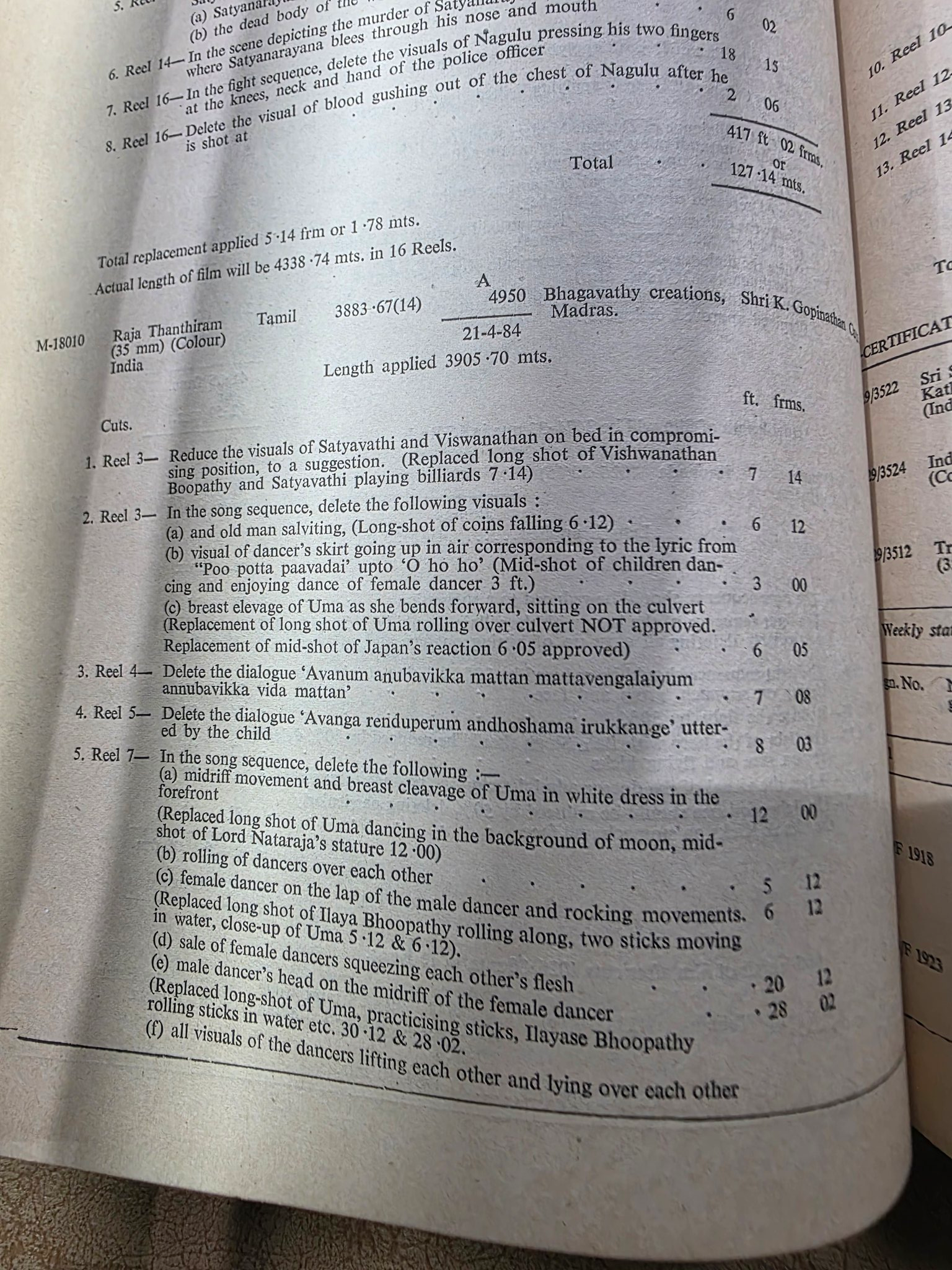
This was both surprising and unsurprising. Unsurprising because this is what the law mandates, each modification to a film must be published in a government gazette for public viewing. Surprising because I had never seen it for myself. CBFC Watch, a project I maintain archiving and collecting film censorship data in India, has had to deal with CBFC’s hostile and frankly garbage portals to liberate that data. Even though this was a different version of the same thing, at least these pages are well-typeset and organized instead of being hidden behind a stupid captcha.
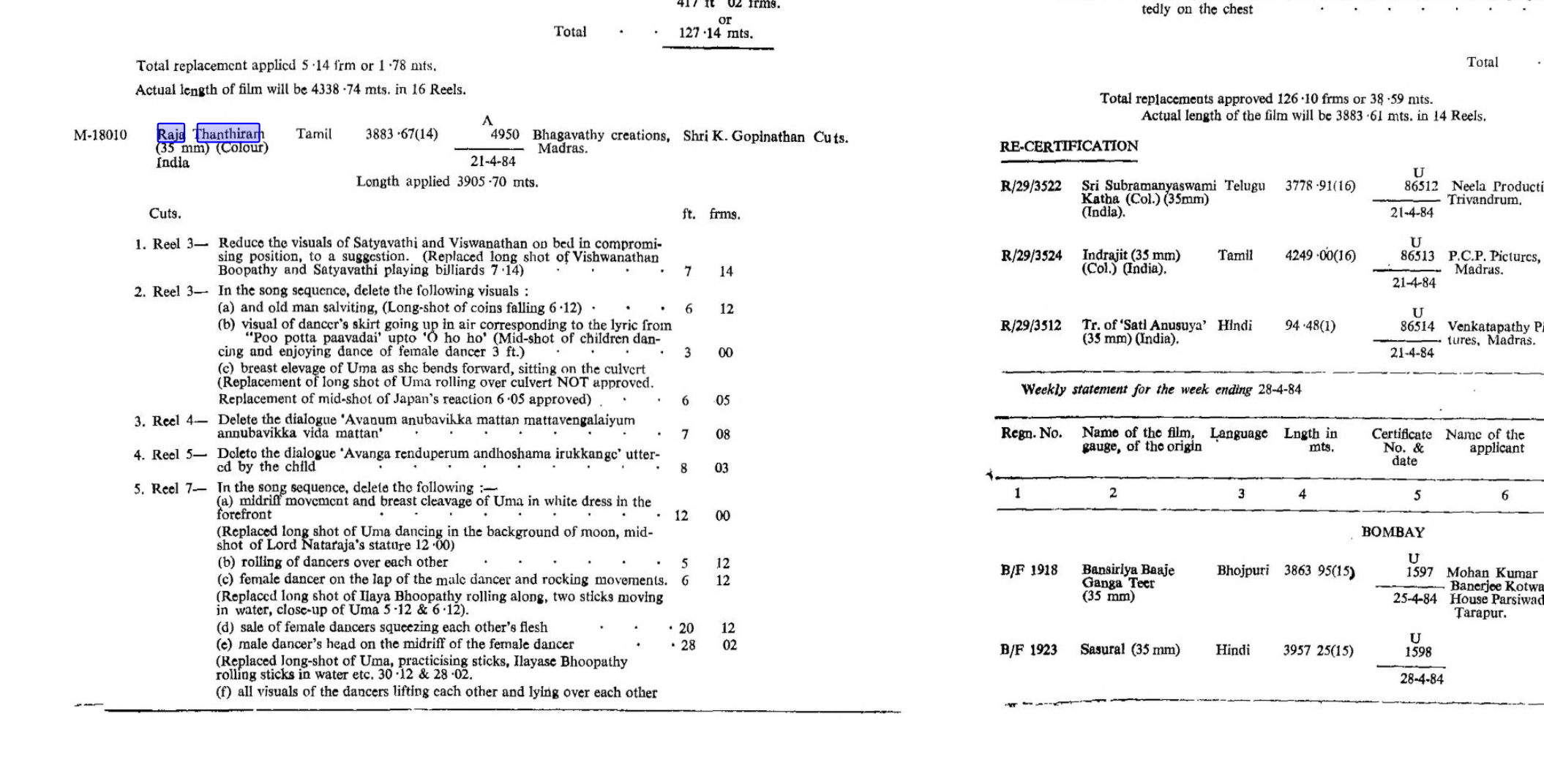
Almost immediately after I shared his post in a friend group, Adhavan found that exact page on JaiGyan’s Internet Archive collection! CRAZY, this was somehow indexed! It’s all thanks to people like JaiGyan, Public Resource, and Servants of Knowledge, who have been scanning and archiving these for us without asking for anything in return. They’ve been building up this collection of gazettes for a long time now, and somewhere in these documents were CBFC cuts waiting to be found again.
I have become more aware of gazettes because of some projects over the last few months. The Federal Register, the USA’s version of the gazettes, calls itself “the Daily Journal of the United States Government” and I find it to be very apt.
I remember reading The Journal of Henry David Thoreau during the pandemic, and the experience is similar: tedious, with bursts of interest. There were pages after pages of him logging which plants had flowered and when, where some particular weed had turned up, walking miles out to the same spot year after year just to catch the exact day a flower opened; but every once in a while, he’ll tie all that obsessive cataloguing together into a wonderful reflection on the activity. After noticing that he only ever seemed to find a plant once he’d started looking for it, he wrote: “Many an object is not seen, though it falls within the range of our visual ray, because it does not come within the range of our intellectual ray, i.e., we are not looking for it. So, in the largest sense, we find only the world we look for.” And you’ll think that reading on was a good thing.
At first glance, a lot of a government gazette is just the government cataloguing its own minutiae in unrelenting detail, at least to me. What you find in all those pages is left to whoever bothers to look through them.
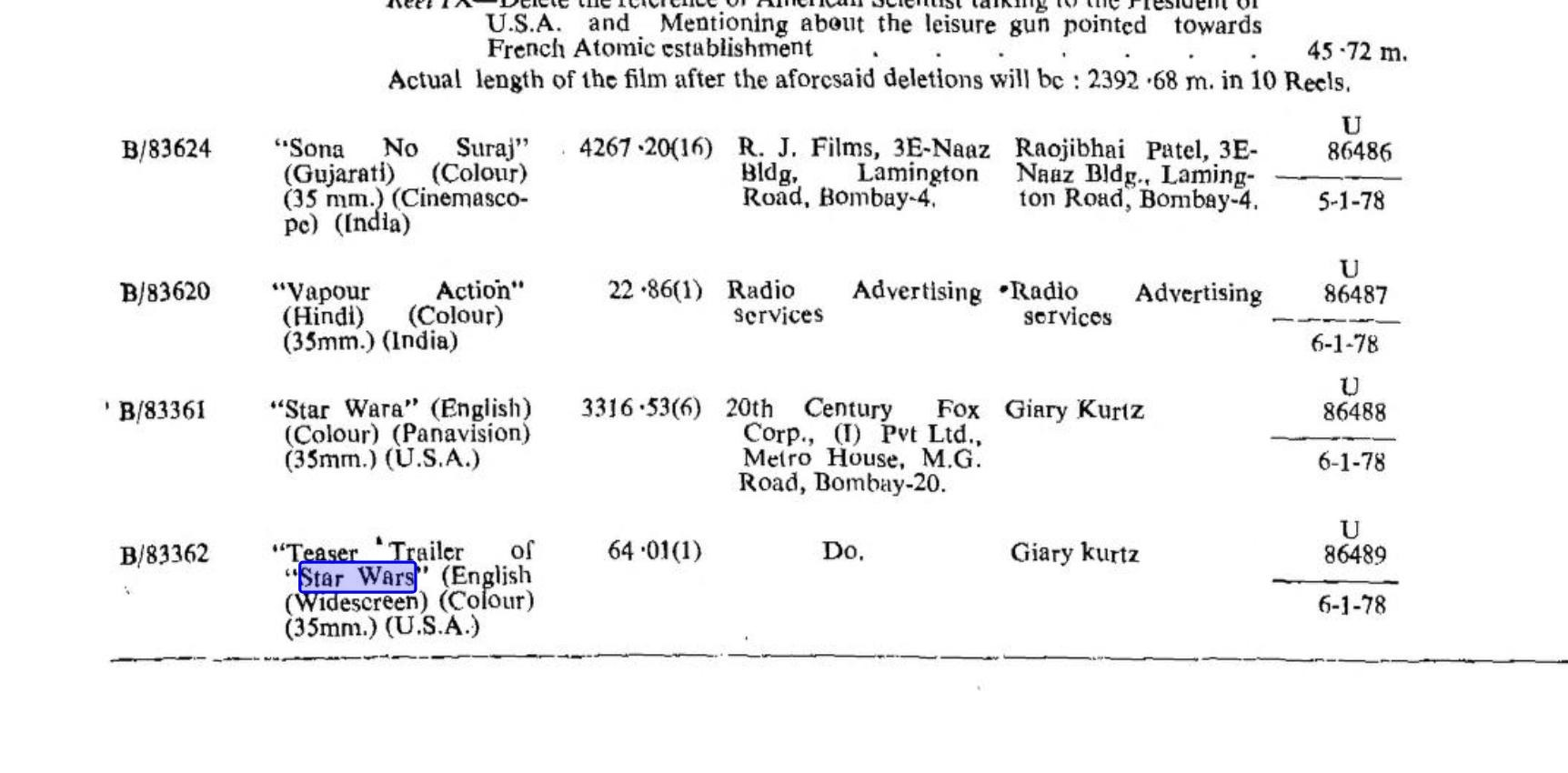
So a good place to start is always something that personally interests you, and then you learn how to navigate to other parts of that landscape. Once I knew I could search for movies, I sat up straight and thought about which movies from the 1960s, 1970s, 1980s, and 1990s I might want to find. First was Star Wars because I found the mental image of a government babu watching and certifying it mildly amusing. I couldn’t find the cut list for the movie, but the trailer was certified.
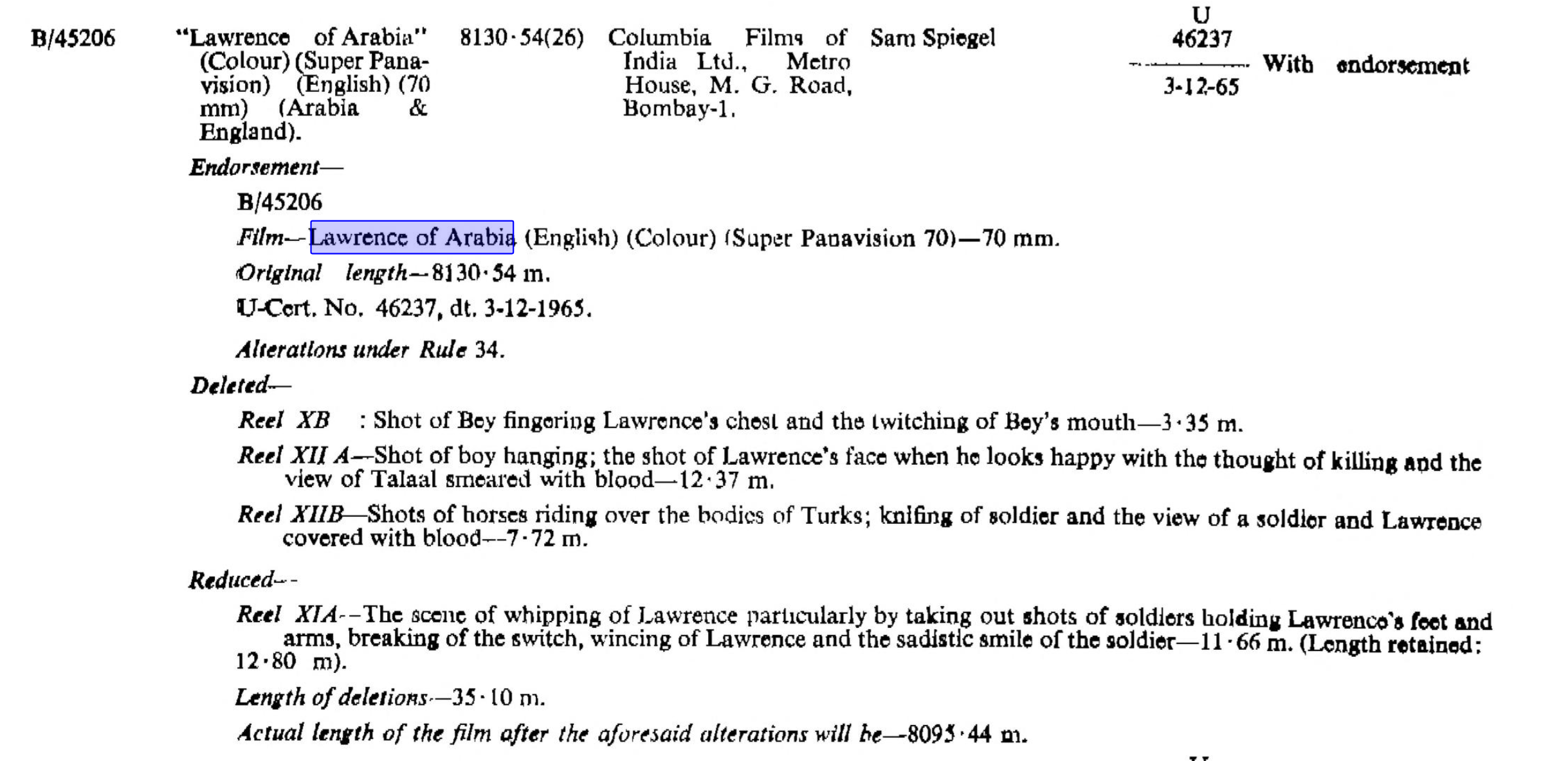
One of my favourite movies of all time is Lawrence of Arabia (1966). So I wrote another search query for it, and sure thing, it was certified in 1966!
I could go on. I found other classics like Sholay, The Exorcist, The Godfather, James Bond films from the era, Taxi Driver and more. Since they have achieved a certain “status” so many decades later, these were the films that came to mind, but due to my ignorance, I have not even considered searching for many more regional cinema classics.
This was a lot of fun; a weirdly unexpected look into past sensibilities. This period a time of great social, economic, and cultural change, and I think we could find signs of that history if we looked more closely at this. These kinds of things were not in CBFC Watch’s dataset because we did not look through old gazettes. So I decided to collect and organize all the movies I could find in the Internet Archive collection (the process for which is very uninteresting and consists of mostly LLM-assisted coding). The basic idea is that every document on the Internet Archive is OCR’d and saved as a plaintext file that can be accessed through an API in addition to being a PDF. I collected all the gazettes in this Archive collection, figured out the patterns for how “censor board” sections appear in that text file, chunked it within those extents and structured the data using the Gemini API. From there, I reused our LLM pipeline for classifying these modifications into broad categories like violence, religious, political etc, as well as cleaning up OCR.
You can find the complete dataset in our data repository (only the gazette extractions. For our dataset of 20k movies liberated from CBFC’s caves, go here).
Here is an exploration of that data. I should warn you that some of the content that follows can be considered not-safe-for-work or “crude”, but if I censor that then…
Before zooming into individual films and certifications, here is the whole archive at a glance. I could find around 8,000 movies (and trailers) in these gazettes. Some years have more movies than others, which could also just mean that the availability of gazettes for that period might be sparse on Internet Archive. You can see the distribution thin out as we approach the 1990s. Alternatively, this could also be the start of the period that they stopped giving as much of a hoot about publishing these in the gazettes too. Who knows?
8,086 censored films by year, by whether the main reason for the cut was Politics & identity, Sex, Violence or something else
In my opinion, one constant throughout the history of Indian censorship has been its infantilising of people when it comes to depictions of intimacy, nudity, and other such blasphemous natural things (for example, the turnips at the Ministry of Education and the Ministry of Culture are currently “clothing” a statue of the Mohenjodaro Dancing Girl that is prehistoric). We do see another trend, which is decreasing amounts of “political” censorship as the decades wear on. It’s possible that there isn’t a lot of data on that or that people are just talking less about those kinds of topics since The Emergency.
It is interesting to see the text of modifications themselves because they recur in predictable ways, depending on which view of the data you take. Politics-wise, it’s clear that for a while, references to communists, Russians, China, and other political or national groups were consistently changed. You would find countless instances of it throughout this dataset, and even to this day, if you were to examine the frequency with which the government has taken issue with “indecorous busts,” kissing, or even “SUGGESTIONS of kissing.” is, by far, the most restricted kind of film content. Unless, of course, you’re making a GDP-boosting movie like Dhurandhar or Animal, in which case, please feel free to do whatever the hell you want to.
I explored these kinds of n-grams and how they showed up in this particular dataset. I still find the political aspects of this time period to be the most interesting.
Commentary comparing self-governing and Communist countries regarding social progress.
Words 'One more disaster to be borne by Korea now struggling to recover from the ravages of Communist aggression'.
All prominent display of girls' bare legs in the dance performance 'Chicka Boom' is deleted.
Shots of Vicky exposing bare thighs and underwear while flourishing her gown in the course of her dance at Hyde Park and, later, at the night club; also, shots of the dancer in silk-gown exposing bare legs were deleted.
Shots of two hard hits in the fight between three persons are deleted.
Shots of hard hits in close views in the fight between Ralph and gangster on the balcony are deleted.
Shots of the female dancer lifted on a drum revealing underwear and again while lying stretched on the drum were deleted.
Delete a shot of a female dancer in a transparent costume revealing her figure while being whirled by a male dancer.
Commanche's attack and fighting, specially close-ups of attacks with axe and dagger, is reduced.
Four close-ups of Pingala where she gives the anarphal to Ashvapati were deleted, with a portion of one close-up retained for continuity.
The passionate kiss between Dick and Ruth is reduced to the minimum.
Delete two passionate kissing scenes.
Most of these films are obscure, and I guess the point isn’t to look any one of them up, but to wander. So here is the rest of the archive as something you can browse! Pick a thread (the Cold War? The Emergency? James Bond? Something else?) or click randomly to read what the censor board altered all those years ago.
If you find this kind of data interesting, please keep CBFC Watch on your radar. We’re still updating it with new movies every few weeks and are the only such dataset for this topic in the country. You can help the archive, which now runs on crowdsourced data, by going to our contributions page when you’re in the theaters next. All it takes is a quick scan with your phone!


